

Let’s face it: the word “asbestos” sounds scary. It brings to mind hazmat suits, huge cleanup costs, and complicated regulations. But if you own or manage a commercial building built before the year 2000, ignoring the problem is actually the scariest (and most expensive) thing you can do.
I’m here to walk you through everything you need to know about asbestos surveys — the legal requirements, the different types, and exactly what happens during one. We’ll keep it simple, add a bit of humour, and by the end, you’ll know exactly which survey you need. 😄
Let’s get into it.
The Non-Negotiable Starting Point: Is a Survey a Legal Requirement? ⚖️
The short answer is: yes, almost certainly. If you own or occupy a non-domestic property (like an office block, a factory, a school, or even a shop) built before the year 2000, you have a legal duty to manage any asbestos present.
This isn’t just a suggestion—it’s the law in the UK under The Control of Asbestos Regulations 2012 (CAR 2012) . This regulation places a duty of care on the “Duty Holder” —the person responsible for the building’s maintenance (typically the owner or the tenant, depending on the lease).
Why? Because asbestos was used so widely. It was called the “magic mineral” for its fireproofing and insulating properties. We didn’t know then what we know now about the health risks. So, if your building was built before 2000, there’s a decent chance it contains asbestos-containing materials (ACMs) .
Think of it this way: You wouldn’t let your plumber blast a hole in a wall without knowing what’s inside. The same logic applies to anyone who visits your building. Failure to commission one of the correct types of asbestos surveys can lead to serious legal sanctions. It’s your job to make sure everyone is safe.
Note: Domestic properties (like your own home) are generally exempt from this “management” duty, but you still need a survey before any major work like a kitchen renovation or loft conversion.
The Old Way vs. The New Way (Type 1, 2, 3 vs. Modern Surveys) 🔄
Before we dive into the details, let’s clear up some old-school jargon you might hear.
For years, surveys were called “Type 1,” “Type 2,” and “Type 3.” This was confusing—even for the pros! Frankly, the system was a bit of a mess. It often led to dutyholders and contractors picking the wrong survey because the names were so unhelpful.
Thankfully, CAR 2012 simplified everything. We don’t talk about types anymore. We talk about survey purposes.
Now, there are just two main survey types for different scenarios—plus a third, equally important one for ongoing management.
The Foundation: Management Asbestos Surveys Explained 👷♂️📝
If I had to pick a starting point for most commercial buildings, this is it. The Management Survey is your baseline, your foundation stone. It’s the survey you need to manage ACMs during the normal, day-to-day occupation and use of your premises.
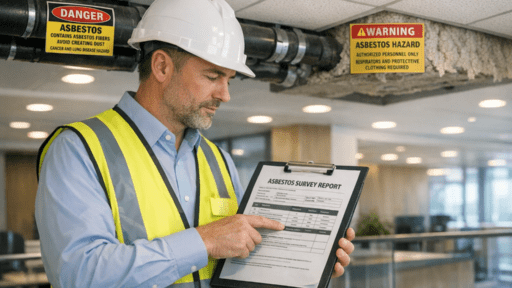
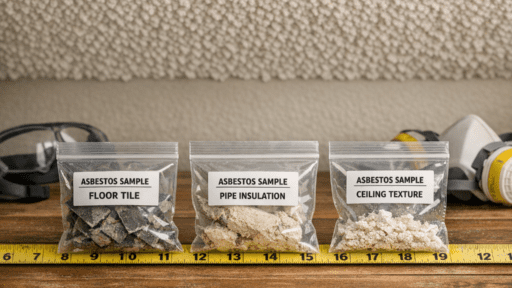
What does it do? It’s a visual inspection of your building. The surveyor will look for potential ACMs—think old floor tiles, insulation boards, ceiling panels, pipe lagging, and textured coatings (like Artex). They can often identify these materials by sight, but they might also take a few small samples for testing.
The goal is NOT to tear the building apart. The level of intrusion is minimal. The surveyor wants to find the ACMs, assess their condition (are they in good nick, or are they damaged and friable?), and give you the information you need to manage them safely.
Why is this survey so important? It creates your asbestos register. This is the document that tells everyone—your employees, visitors, and most importantly, any tradesmen who show up—exactly where the risks are. Once you have your register, you need an asbestos management plan. This plan outlines how you’ll monitor the ACMs and what to do if they’re disturbed.
A top tip here: your management plan is not a “set it and forget it” task. You must review it after any significant changes to the building (like a new air conditioning unit), or at least once a year. That’s a legal requirement.
The Big Guns: Refurbishment and Demolition Surveys Explained 🏗️💥
Now, let’s say you’re not just occupying the building. You’re going to change it. You’re knocking down a wall to create an open-plan office. You’re installing a new heating system. You’re plastering over those old Artex ceilings. You’re demolishing the whole place.
At this point, your standard Management Survey isn’t enough. You need a Refurbishment/Demolition Survey.
This is the most invasive type of survey. The surveyor’s job is to get right into the fabric of the building. They need to find ACMs that even a Management Survey might miss—like asbestos in floor screed, behind wall panels, or inside a lift shaft. The sample area should be vacant during the survey because it will be destructive (think pulling up floorboards, breaking through ceiling tiles, and cutting into walls).
Why is this required? Simply put, it keeps people alive. When you start demolishing a wall, you don’t want to turn it into a cloud of deadly dust. This survey ensures that the work can be done safely. It tells the builders exactly where the ACMs are, so they can be removed by a licensed contractor before the main work starts.
Carrying out refurbishment or demolition work without this survey is a serious potential breach of CAR 2012. You are putting your workers and the public at risk, and you are inviting legal trouble. Don’t do it.
Even in a domestic property (your house), if you’re doing a loft conversion or rewiring the whole place, you should commission this survey to protect the tradesmen working there. Their employers have a duty to protect them under Regulations 5 & 6 of CAR 2012.
Keeping it Up-to-Date: The Ongoing Role of the Re-inspection Survey 📅🔁
So, you’ve got your Management Survey, you have an asbestos register, and you think you’re done. Not quite. 😉
This is where the Re-inspection Survey comes in. This isn’t a separate “type” of initial survey, but rather an essential part of your ongoing management plan.
What is it? It’s a process of revisiting your premises to check on the condition of the ACMs you already know about. You might do this every 6, 9, or 12 months, or after any event that could have damaged the materials (like a leak or a repair from a contractor who wasn’t careful).
Why is it necessary? Asbestos doesn’t stay safe forever. A perfectly sound asbestos floor tile can be cracked by a heavy machine. The insulation board around a boiler can become friable over time. You need to know when the condition of an ACM has changed from “good” to “poor” so you can act.
By doing this, you create chronological evidence that you are diligently managing your legal duty. It’s your proof that you didn’t just tick a box once and then forget about it. It’s a crucial part of your overall risk management strategy.
Many companies, like RB Asbestos, offer this as a managed service for their clients, giving them peace of mind. They keep track of your buildings and send you reminders. It’s a simple, effective way to ensure you never fall out of compliance.
Who Conducts These Surveys? The Human Factor 🧑🔬🎓
You wouldn’t let a hairdresser perform open-heart surgery. Similarly, you shouldn’t let just anyone with a clipboard conduct an asbestos survey.
All surveyors must be appropriately trained and monitored. The benchmark standard is the Health and Safety Guidance Document HSG 264, which was replaced by HSG 248 in 2021 (though the practical guidelines remain similar). This document sets out the procedures and quality standards for managing asbestos surveys.
What should you look for in a surveyor?
- Accreditation: Look for UKAS accreditation (ISO 17020) for inspection bodies. This means they’ve been independently audited and are competent.
- Experience: You want a surveyor who has seen it all. Experienced professionals (like those with a decade or more in the field, as mentioned in our source) can identify ACMs just by looking at them, reducing the need for unnecessary destructive sampling.
- Insurance: They must have adequate professional indemnity and public liability insurance.
Remember, you are relying on their report to keep people safe and to prove you have met your legal duties. This is not an area where you cut corners or choose the cheapest option.
The Domino Effect: What Happens After a Survey? 🎯📄
Getting the survey is just the first step. Once you get that report back, a whole world of responsibility opens up. Here’s a typical flow of events:
1. Receive your Asbestos Register: This will be a detailed document (often a PDF or a web-based system) listing every ACM found in the building, its location (e.g., “Behind panel A in corridor B”), its type, its condition (1, 2, or 3), and the recommended action.
2. Assess the Risks: Your duty holder’s role is to evaluate the survey. A material with a high asbestos content in a poor condition (e.g., damaged, flaking lagging) is a high risk. A material with low asbestos content in good condition (e.g., an intact floor tile) is a very low risk.
3. Create a Management Plan: This is your action plan. For the high-risk ACMs, you might need to remove them. For low-risk, in-tact ACMs, the best course of action is often to manage in-situ—which means leaving it alone, labelling it, and inspecting it regularly. The plan should also include how to inform tradesmen.
4. Inform Everyone: Every employee, contractor, or visitor who could disturb an ACM must be told about it. This could be through training, a site induction, or simply a sign on a door.
5. Review and Re-inspect: This is where the Re-inspection Survey comes in. You set a schedule (e.g., annually) to check the condition of all managed ACMs. If the condition changes, you update your plan.
A real-life example: A client of mine had a beautiful old school building with an intact asbestos ceiling tile in a hallway. The management survey said “Good condition.” We recommended a “manage in-situ” plan. We labelled the tile, and the caretaker was trained. Six months later, a plumber accidentally cracked it while fixing a pipe. Because we had a re-inspection schedule in place, we immediately scheduled a licensed removal. The damage was contained, and everyone was safe. The survey and the plan made all the difference.
Common Questions and Pitfalls to Avoid 😅❌
Let’s be honest, asbestos management can be a minefield. Here are a few common mistakes I see people make, so you can avoid them.
Mistake #1: The “It’s My House” Fallacy 🏡 “I live here, so I don’t need a survey.” This is true for managing asbestos, but as we discussed, it’s 100% false for renovating. If you’re doing DIY on an old house, you are the duty holder for your tradesman’s safety. Don’t be the person who creates a hazard for the next person.
Mistake #2: “We’re Just Changing a Lightbulb” 💡 Any work that can disturb the building fabric—drilling, cutting, sanding, chasing—needs the information from a survey. You can’t assume a wall is safe just because you haven’t seen it. Always check the register.
Mistake #3: “The Price Seems Too High” 💸 Asbestos surveys are not cheap. But compare the cost of a proper survey to the cost of not having one. A single claim from a worker who gets asbestosis could run into the hundreds of thousands of pounds, plus unlimited legal fees and reputational damage. The survey is an investment in safety and compliance.
Mistake #4: “Back in 2012, it was done” 🕰️ The regulations may have been updated, but the asbestos hasn’t gone anywhere. The condition of ACMs can change over time. A survey from 10 years ago is useless for today’s management plan.
A bit of humour to lighten the mood: An asbestos survey is a bit like your annual health check-up. You don’t want to go, you’re a bit nervous, but it’s always better to know about a problem early than to find out about it in the emergency room. Your building feels the same way. 😉
Bringing It All Together: Which Survey Do You Need? 🧩
To make it super simple, let’s break it down into a decision tree. Think about what you are doing with the building.
- Question 1: Are you doing any building work, demolition, or major refurbishment?
- Yes? You need a Refurbishment/Demolition Survey.
- No? Go to Question 2.
- Question 2: Do you currently have a valid Management Survey and an Asbestos Register?
- No? You need a Management Survey immediately.
- Yes? Go to Question 3.
- Question 3: When was your last Re-inspection?
- More than a year ago? You need a Re-inspection Survey to update your plan.
- Less than a year ago? You are in great shape! Just keep to your schedule.
It’s really that simple. Most commercial property owners only need to deal with the Management and Re-inspection cycle. The Refurbishment/Demolition survey is a special event that happens at a specific time.
Conclusion: Your Building, Your Responsibility ✅
Managing asbestos doesn’t have to be overwhelming. It’s a process. Follow the rules, hire a qualified professional, and don’t cut corners.
Start with a Management Survey. Get your asbestos register in place. Implement your management plan. Then, lock into a regular Re-inspection cycle. And if you’re ever planning a major change to the building, remember the Refurbishment/Demolition Survey.
By doing this, you are not just ticking a legal box. You are protecting people from a very real danger. And that’s something to be proud of. 🙌
If you have any doubts, just pick up the phone. Good consultants (like the experienced team at RB Asbestos Consultants) will walk you through it for free. They’ll ask you about your building and your plans before you even book a survey.
Frequently Asked Questions (FAQs) ❓
Q1. How long does an asbestos survey take? A. It depends on the size of the building. A small office might take a few hours, while a large factory could take several days. The surveyor will be working methodically, checking every accessible area.
Q2. What happens if my survey finds a lot of asbestos? A. Don’t panic! It doesn’t automatically mean a huge removal bill. Many ACMs in good condition can be safely left in place and managed. The survey report will tell you the condition and recommend an action (remove, repair, or manage in-situ).
Q3. Can I do an asbestos survey myself? A. Technically, the law doesn’t prohibit a homeowner or dutyholder from doing their own survey. However, it is highly inadvisable. You would need to be a competent person, able to identify asbestos, know its risks, and be trained in sample-taking. In my opinion, it’s best to hire a professional.
Q4. What is the difference between an asbestos survey and an asbestos test? A. A survey is the whole process of inspecting a building and identifying ACMs. As part of that, a surveyor may take bulk samples of suspect materials to be tested in a laboratory. A test is just the lab analysis itself. You can have a sample tested without a full survey, but you miss the crucial visual inspection and risk assessment.
Q5. What is “HSG 264” vs “HSG 248”? A. HSG 264 (Asbestos: The survey guide) was the standard for many years. It has been replaced by HSG 248 (Asbestos: The survey guide) . The new guide, published in 2021, updates the procedures, including clearer guidance on sampling strategies and the competency of surveyors. A good surveyor will be working to the latest HSG 248 standard.
Disclaimer: This content is for informational purposes only. Always consult a licensed asbestos professional for surveys, removal, or compliance with local regulations.